
Artificial intelligence (AI) continues to reshape the semiconductor industry, and NVIDIA Corporation NVDA and Advanced Micro Devices, Inc. AMD remain at the center of this transformation. Both companies are expanding rapidly as cloud providers, enterprises and AI developers spend heavily on AI infrastructure. While NVDA still dominates the AI accelerator market, AMD is making meaningful progress with its Instinct GPUs (graphics processing units) and EPYC server processors.
The question for investors is whether Advanced Micro Devices’ faster stock rally makes it the better opportunity, or if NVIDIA’s unmatched leadership still makes it the stronger long-term investment.
NVIDIA: The Undisputed AI Computing Chip Leader
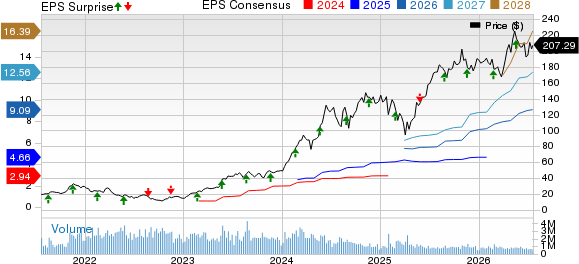
NVIDIA continues to dominate the AI computing space. The company’s last reported results for first-quarter fiscal 2027 were another exceptional financial performance. First-quarter revenues soared 85% year over year to $81.6 billion as data center sales jumped 92% to a record $75.2 billion. Non-GAAP earnings surged 140% to $1.87 per share.
NVIDIA Corporation Price, Consensus and EPS Surprise

NVIDIA Corporation price-consensus-eps-surprise-chart | NVIDIA Corporation Quote
The rapid adoption of its Blackwell platform, strong networking demand and growing deployment across hyperscalers, enterprises and sovereign AI projects continue to strengthen its competitive position. During the lastearnings call management highlighted expanding opportunities in AI infrastructure, forecasting industry spending could eventually reach trillions of dollars annually.
Beyond GPUs, NVIDIA is widening its moat through networking, software and AI systems. CUDA remains the industry’s preferred AI software ecosystem, making it difficult for customers to switch platforms. The company is also entering the data center CPU (central processing unit) market with Vera, creating another long-term growth engine.
Its enormous free cash flow supports higher shareholder returns through dividends and share repurchases while funding aggressive research and development. During the first quarter of fiscal 2027, NVIDIA generated $50.3 billion in operating cash flow and $48.6 billion in free cash flow. The company returned $243 million to its shareholders through dividend payouts and repurchased stocks worth $19.3 billion in the first quarter.
However, NVIDIA is not without risks. The company faces export restrictions to China, an increasingly competitive AI market and the challenge of sustaining extraordinary growth after several years of explosive expansion.
AMD: A Strong Challenger With Growing AI Momentum
Advanced Micro Devices is steadily strengthening its position in AI infrastructure. The company’s first-quarter 2026 revenues climbed 38% year over year to $10.3 billion, driven by record data center revenues of $5.8 billion, which increased 57%. Non-GAAP earnings jumped 43% year over year to $1.37 per share.
Advanced Micro Devices, Inc. Price, Consensus and EPS Surprise

Advanced Micro Devices, Inc. price-consensus-eps-surprise-chart | Advanced Micro Devices, Inc. Quote
Advanced Micro Devices is witnessing strong demand for its EPYC server processors. The company’s Instinct AI accelerators continue to gain traction as customers move from pilot projects to production deployments. During the first-quarterearnings call management expressed confidence that AI accelerator revenues could reach tens of billions of dollars annually in 2027, supported by growing partnerships with Meta, OpenAI and major cloud providers.
Advanced Micro Devices’ biggest strength is its broad portfolio. Along with AI GPUs, it continues to gain server CPU market share, expand its AI PC offerings and improve its ROCm software platform. These efforts are making AMD a more credible alternative to NVIDIA.
Strong revenue growth and improving profitability are helping Advanced Micro Devices generate huge cash flows. In the first quarter of 2026, AMD reported $3 billion of cash from continuing operations and free cash flow of $2.6 billion.
Nonetheless, challenges remain for the company. NVIDIA continues to dominate the AI accelerator market with a much stronger software ecosystem and a larger installed customer base. Advanced Micro Devices also expects higher memory and component costs to weigh on PC and gaming demand during the second half of 2026. AMD’s share buybacks are not massive as it continues to invest heavily to narrow the technology gap with NVDA. In the first quarter of 2026, it repurchased shares worth $221 million.
NVIDIA vs. AMD: Which Has a Better Growth Outlook?
Both companies are benefiting from growing spending on AI infrastructure buildouts by hyperscalers and enterprises, but analysts appear more optimistic about NVIDIA’s growth outlook.
The Zacks Consensus Estimate for NVIDIA’s fiscal 2027 revenues and earnings indicates year-over-year growth of 80% and 90.6%, respectively. The consensus mark for fiscal 2027 earnings has also been revised upward by 4.36% over the past 60 days. The meaningful upward earnings estimate revision reflects growing confidence that sustained AI investments will continue to support NVDA’s earnings growth.
NVDA Consensus EPS Estimate Revision Trend

Image Source: Zacks Investment Research
On the other hand, the Zacks Consensus Estimate for Advanced Micro Devices’ 2026 revenues and earnings indicates year-over-year growth of 42.3% and 74.6%, respectively. AMD is also seeing positive estimate revisions, although the magnitude is relatively smaller. During the past 60 days, the consensus estimate for 2026 earnings has increased by 0.97%. While this remains encouraging, it suggests that analysts currently see stronger earnings momentum at NVIDIA.
AMD Consensus EPS Estimate Revision Trend
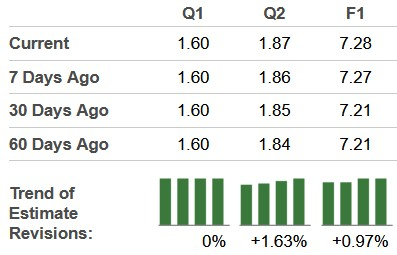
Image Source: Zacks Investment Research
Valuation: NVIDIA Offers Better Value Than AMD
At first glance, Advanced Micro Devices’ 154.3% year-to-date rally far exceeds NVIDIA’s 10.9% gain, reflecting growing investor confidence in its AI ambitions. However, the sharp rise has also pushed AMD’s valuation significantly higher.
NVIDIA currently trades at a forward 12-month price-to-earnings (P/E) multiple of 19.31, well below Advanced Micro Devices’ 53.04. That is notable because NVIDIA is delivering much faster revenue growth, stronger profitability, significantly higher free cash flow and remains the clear leader in AI accelerators. AMD remains an attractive long-term AI company, but much of its near-term optimism already appears reflected in its valuation.
NVIDIA vs. AMD: Which AI Stock Wins?
Both NVIDIA and Advanced Micro Devices are well-positioned to benefit from the long-term AI investment cycle. AMD is executing well, gaining market share and building stronger customer relationships that should support years of growth.
However, NVIDIA continues to outperform on nearly every major metric, including revenue growth, profitability, software leadership, ecosystem strength, cash generation and shareholder returns. Combined with its lower valuation multiple, NVIDIA offers a more compelling balance of growth and value. For investors looking to capitalize on the AI boom today, NVIDIA remains the better investment bet.
Currently, NVIDIA sports a Zacks Rank #1 (Strong Buy), giving it a clear edge over Advanced Micro Devices, which carries a Zacks Rank #2 (Buy). You can see the complete list of today’s Zacks #1 Rank stocks here.
Beyond Nvidia: AI’s Second Wave Is Here
The AI revolution has already minted millionaires. But the stocks everyone knows about aren’t likely to keep delivering the biggest profits. AI’s second wave is moving from infrastructure to implementation and these companies are at the forefront of this transition, positioned to become what Amazon and Google were to the internet era.
Advanced Micro Devices, Inc. (AMD) : Free Stock Analysis Report
NVIDIA Corporation (NVDA) : Free Stock Analysis Report
This article originally published on Zacks Investment Research (zacks.com).
5 Stocks Our Experts Predict Could Double In the Next Year
By submitting your email, you'll also get a free pivot & flow membership. A free daily market overview. You can unsubscribe at any time.