
Key Points
-
Amazon-owned Zoox just received federal approval for up to 2,500 driverless vehicles annually.
-
It’s the first approval for a purpose-built driverless vehicle with no manual controls.
-
While Tesla is slowly expanding its driverless rides, it remains restricted without approvals.
- 10 stocks we like better than Amazon ›
The race to operating fleets of driverless vehicle robotaxis is heating up among a number of significant competitors. Alphabet‘s (NASDAQ: GOOG)(NASDAQ: GOOGL) Waymo has already tallied up more than 220 million fully autonomous miles, rider-only with no supervision. Tesla‘s (NASDAQ: TSLA) Cybercab ambitions are well publicized, even if its driverless programs are only slowly expanding. But it was actually Amazon (NASDAQ: AMZN) that recently landed a big win against its competitors.
Details on Amazon approval
Amazon-owned Zoox was just given temporary permission by the National Highway Traffic Safety Administration (NHTSA) to commercially deploy steering-wheel-free robotaxis, adding pressure to the robotaxi competition. This is significant because the vast majority of competitors, such as Waymo, are modifying traditional passenger cars. The difference is that the Zoox vehicle was developed from the ground up and is produced without manual controls, making it the first purpose-built driverless vehicle to receive approval.
Where to invest $1,000 right now? Our analyst team just revealed what they believe are the 10 best stocks to buy right now, when you join Stock Advisor. See the stocks »
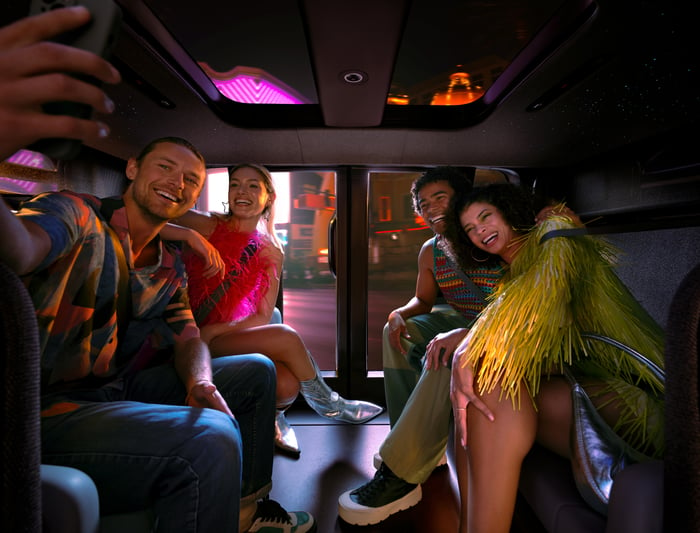
Zoox vehicle in Las Vegas. Image source: Amazon.
“We can say pretty clearly that the systems in place on the Zoox exceed the equivalent performance requirements of a compliant vehicle,” said the NHTSA’s Jonathan Morrison regarding the agency granting temporary approval.
Zoox said the NHTSA’s approval gives the company the federal go-ahead to begin charging for rides. Zoox acknowledged it would begin charging for its service in Las Vegas first, with additional markets to follow after various state requirements are met. Zoox’s approval enables the company to commercially deploy up to 2,500 vehicles annually for two years, or a total of 5,000 vehicles.
It’s a big win for Zoox against Waymo and Tesla, which are also racing to expand their autonomous ride-hailing services. While Waymo remains the clear market leader in operating paid fleets in multiple areas, this serves notice that a significant competitor with Amazon’s backing will be a long-term competitor with the ability to scale.
What it all means
For Tesla, it’s a reminder that it still has to get its own approval federally, and without it, its physical fleet will be legally restricted compared to Zoox’s. Currently, Tesla’s robotaxi service is operating unsupervised rides with Model Y vehicles in Austin, Dallas, Houston, Miami, Orlando, and Tampa.
While it’s fair to say that Tesla CEO Elon Musk has been incorrectly predicting the mass rollout of autonomous vehicles for almost a decade, he isn’t pulling back. In fact, he recently predicted via a video call at the Samson International Smart Mobility Summit in Tel Aviv that “10 years from now probably 90% of all distance driven will be driven by the AI in a self-driving car.”
There’s a lot riding on the driverless vehicle business for long-term Tesla investors. The company’s massive market capitalization is supported by the belief that the company’s transition from a traditional automaker to one that revolves around humanoid robots, robotaxi fleets, and artificial intelligence will grant it a more lucrative future. Currently, Tesla’s robotaxi ambitions seem more hype than reality, and for investors, that’s something that needs to change in the near term. Zoox receiving federal approval and beginning to charge for rides only applies more pressure for Tesla and Waymo.
Should you buy stock in Amazon right now?
Before you buy stock in Amazon, consider this:
The Motley Fool Stock Advisor analyst team just identified what they believe are the 10 best stocks for investors to buy now… and Amazon wasn’t one of them. The 10 stocks that made the cut could produce monster returns in the coming years.
Consider when Netflix made this list on December 17, 2004… if you invested $1,000 at the time of our recommendation, you’d have $395,463!* Or when Nvidia made this list on April 15, 2005… if you invested $1,000 at the time of our recommendation, you’d have $1,268,290!*
Now, it’s worth noting Stock Advisor’s total average return is 927% — a market-crushing outperformance compared to 211% for the S&P 500. Don’t miss the latest top 10 list, available with Stock Advisor, and join an investing community built by individual investors for individual investors.
*Stock Advisor returns as of August 5, 2026.
Daniel Miller has no position in any of the stocks mentioned. The Motley Fool has positions in and recommends Alphabet, Amazon, and Tesla. The Motley Fool has a disclosure policy.
5 Stocks Our Experts Predict Could Double In the Next Year
By submitting your email, you'll also get a free pivot & flow membership. A free daily market overview. You can unsubscribe at any time.