
Key Points
-
AMD estimates its second-quarter revenue will grow 35% year over year.
-
AMD trades at a higher premium than the industry leader, Nvidia.
-
Investors should avoid trying to time the market based on earnings because they have no direct correlation to stock price movements.
- 10 stocks we like better than Advanced Micro Devices ›
AMD estimates its second-quarter revenue will grow 35% year over year.
AMD trades at a higher premium than the industry leader, Nvidia.
Investors should avoid trying to time the market based on earnings because they have no direct correlation to stock price movements.
Advanced Micro Devices (NASDAQ: AMD) (AMD) has been a beneficiary of the artificial intelligence (AI) boom, with the stock up an impressive 94% in the past three years (as of July 28). What’s even more impressive is that it has been able to do so while playing little brother to Nvidia (NASDAQ: NVDA) in the graphics processing unit (GPU) space, a key component of data centers that makes AI possible.
On Aug. 5, AMD is set to report its fiscal second-quarter earnings, which many anticipate being solid. If revenue comes in around $7.4 billion, like the company estimates, it would’ve grown business by 35% year over year. Not too shabby at all.
Where to invest $1,000 right now? Our analyst team just revealed what they believe are the 10 best stocks to buy right now. Learn More »
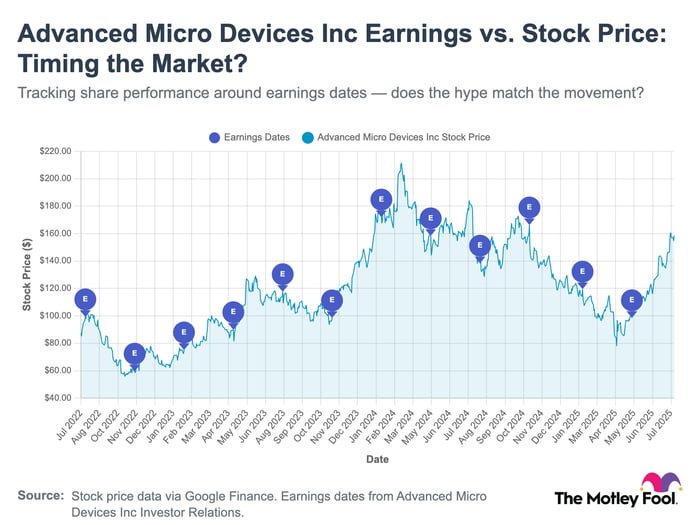
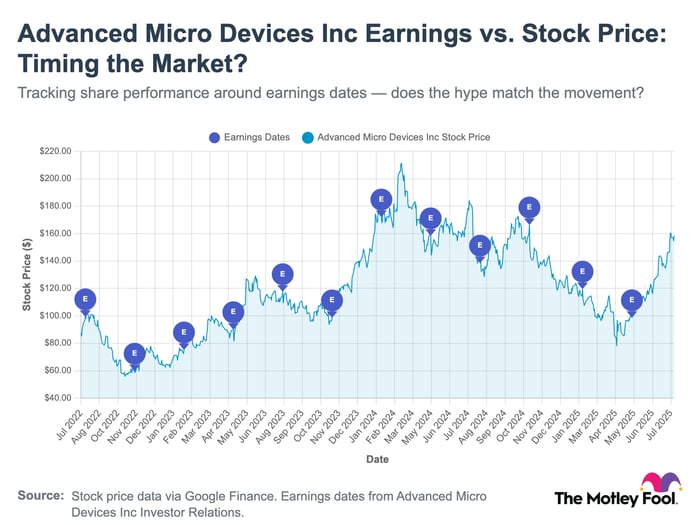
This anticipated earnings growth has many investors wondering whether they should buy the stock before Aug. 5 to take advantage of a potential price boost. However, history says that might not be the best thought process.
Beating earnings expectations doesn’t equal immediate stock price growth
AMD is no stranger to beating earnings estimates. In its past 10 quarters, it has met or beaten earnings-per-share (EPS) estimates, yet there’s been no consistency in how its stock price performs immediately after. This shows investors are considering more than just earnings when deciding how to value the stock.
Anticipating how a stock’s price will move based on earnings can often be counterproductive because the stock market doesn’t behave rationally. A much better approach, if you believe in the company long-term, would be dollar-cost averaging to help offset some of the inevitable volatility.
Be prepared to pay a premium for AMD’s stock
Whether you buy AMD shares before or after its Aug. 5 earnings, you should be prepared to pay a premium for the company. It’s trading at over 43 times its forward earnings, which is higher than Nvidia, the leader in the space.
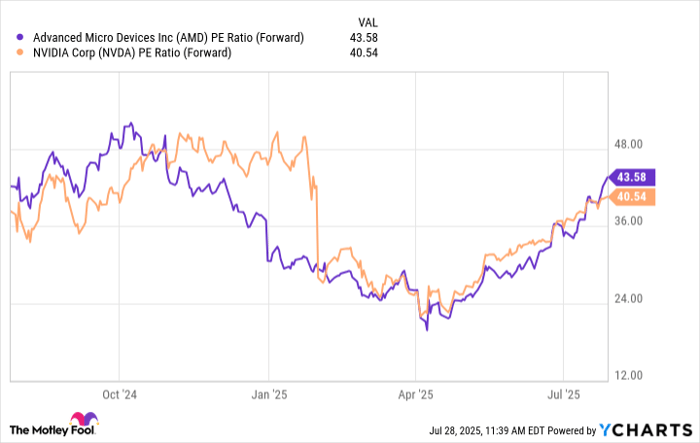
AMD PE Ratio (Forward) data by YCharts.
AMD’s premium price isn’t inherently a problem, but it makes it a lot harder to justify compared to Nvidia, which is growing revenue at a much faster pace. Trading at 40 times forward earnings is also expensive, but Nvidia’s revenue in its last quarter increased 69% year over year, and it’s the industry leader.
While the ultimate decision to invest in AMD shouldn’t revolve around Nvidia, it does help put the stock’s valuation into perspective. In either case, approach the stock with a long-term mindset, and don’t invest based on what you anticipate the stock will do post-earnings.
Should you invest $1,000 in Advanced Micro Devices right now?
Before you buy stock in Advanced Micro Devices, consider this:
The Motley Fool Stock Advisor analyst team just identified what they believe are the 10 best stocks for investors to buy now… and Advanced Micro Devices wasn’t one of them. The 10 stocks that made the cut could produce monster returns in the coming years.
Consider when Netflix made this list on December 17, 2004… if you invested $1,000 at the time of our recommendation, you’d have $633,452!* Or when Nvidia made this list on April 15, 2005… if you invested $1,000 at the time of our recommendation, you’d have $1,083,392!*
Now, it’s worth noting Stock Advisor’s total average return is 1,046% — a market-crushing outperformance compared to 183% for the S&P 500. Don’t miss out on the latest top 10 list, available when you join Stock Advisor.
*Stock Advisor returns as of July 29, 2025
Stefon Walters has no position in any of the stocks mentioned. The Motley Fool has positions in and recommends Advanced Micro Devices and Nvidia. The Motley Fool has a disclosure policy.
5 Stocks Our Experts Predict Could Double In the Next Year
By submitting your email, you'll also get a free pivot & flow membership. A free daily market overview. You can unsubscribe at any time.