Small Caps Surge: Russell 2000 ETF Sees Over $6 Billion Inflows Small Caps Surge: Russell 2000 ETF Sees Over $6 Billion Inflows

Written By Michael Gary Scott

Amidst the ever-fluctuating tides of the stock market, investors have set their sights on small-cap stocks, anticipating a windfall in the wake of an impending Federal Reserve rate cut cycle.

The month of July has been nothing short of transformational, as small caps have outshone their larger counterparts by a significant margin, particularly within the tech sector. This newfound dominance of small caps has come at the heels of a nearly two-year tech bull market.

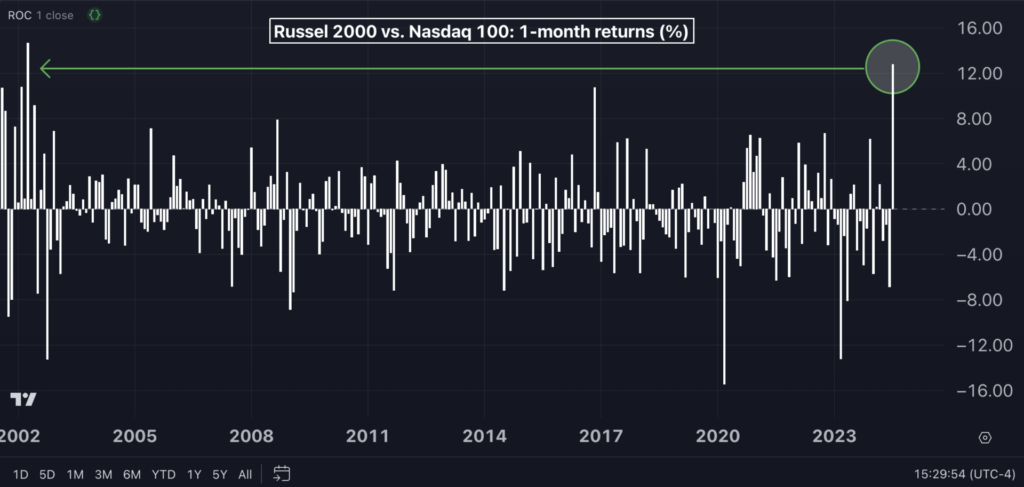
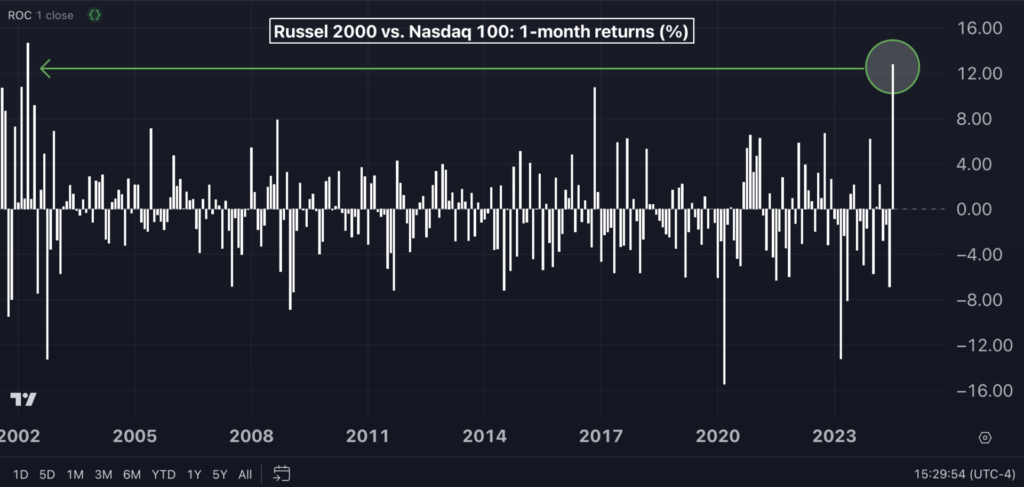
The Russell 2000 index has been a beacon of success, soaring nearly 9% month-to-date, juxtaposed against a 3.6% dip in the tech-heavy Nasdaq 100 as of July 25.

The staggering performance divergence of almost 13 percentage points in favor of the Russell 2000 over tech in this short span echoes what experts would frame as the best month for the “long small cap, short tech” exchange since April 2002, showcasing the decisive nature of the ongoing market reorientation.

Charting Two Decades’ Best Month for ‘Long Russell 2000, Short Nasdaq 100’

Robust Inflows Into Small-Cap ETFs

The remarkable performance of small-cap stocks has been mirrored by substantial flows of capital into prominent small-cap-focused ETFs.

The iShares Russell 2000 ETF IWM, a behemoth among ETFs tailing the U.S. small-cap index, has seen over $6 billion in net inflows so far this month, marking a record influx in 2024 as per data from Etfdb.com.

Several other small-cap ETFs have also been beneficiaries of considerable investor interest this month:

  • iShares Core S&P Small-Cap ETF IJR: $645 million in net inflows
  • Avantis U.S. Small Cap Value ETF AVUV: $553.28 million in net inflows
  • Invesco S&P SmallCap Momentum ETF XSMO: $350 million in net inflows
  • SPDR Portfolio S&P 600 Small Cap ETF SPSM: $188 million in net inflows

Year-to-date, the Vanguard Small-Cap ETF VB and the Pacer US Small Cap Cash Cows 100 ETF CALF have been the primary magnets for investor capital, raking in $3.1 billion and $2.9 billion respectively.

See also  <!DOCTYPE html><html lang="en"><head> <meta charset="UTF-8"> <meta http-equiv="X-UA-Compatible" content="IE=edge"> <meta name="viewport" content="width=device-width, initial-scale=1.0"> <title>Analysis: The Rise of Infrastructure Stocks in America</title></head><body> <article> <h2>Reviewing the Close of the Third Quarter 2024</h2> <p> As the pages turn on the Third Quarter of 2024 in the annals of U.S. equity markets, stalwart as ever, they reveal little change. While investors weathered some turbulence, the bulls, with unwavering determination, notched yet another win as the revered S&P 500 Index ETF (SPY) ascended for the fourth consecutive month. </p> <p> Despite burgeoning global tensions in the Middle East and Europe, a seismic jobs revision, and apprehension surrounding the “Yen Carry Trade,” the S&P 500 defied the odds, scaling the wall of worry to culminate the quarter with an almost 5% incline. Liquidity and the all-encompassing Federal Reserve, as often observed, have been the primary forces propelling stocks forward, setting the stage for the forthcoming Q4 and its accompanying earnings symphony. </p> <h2>Unveiling Industry Insights</h2> <h3>The Unyielding Ascendancy of Artificial Intelligence Stocks</h3> <p> A momentary dip in margins at the revered Nvidia (NVDA) and a stormy short report aimed at the AI behemoth Super Micro Computer (SMCI) painted a picture of a slackening AI revolution. Nonetheless, the standout earnings performance by database magnate Oracle (ORCL) stood as a bulwark against these concerns. Besides, a titanic revelation dawned as CEO Larry Ellison and the visionary Elon Musk jointly implored Nvidia's CEO Jensen Huang for an upsurge in GPUs. </p> <p> Palantir Technologies (PLTR), the architect behind data analytics platforms that empower governments and organizations to decipher vast datasets using AI, emerged as a victor, boasting a remarkable 44.89% swell in Q3. PLTR's surge was steered by an upsurge in quarterly earnings (+80% year-over-year) and its esteemed inclusion in the S&P 500 Index. </p> <h3>The Empowering Role of Utilities Stocks in the AI Evolution</h3> <p> History teaches us that the surefire way to harvest colossal profits often hinges on vending the “picks and shovels.” In the intensifying quest for AI mastery, tech behemoths are injecting billions into energy-intensive data centers essential for AI model training. Utility stocks emerged as the prime beneficiaries in Q3. Constellation Energy (CEG) rocketed by nearly 30% for the quarter subsequent to Microsoft's (MSFT) groundbreaking accord to resuscitate “Three Mile Island.” </p> <p> <strong>Space Stocks Soar to New Heights</strong> </p> <p> Once deemed a whimsical dream due to the arduous journey to space and exorbitant costs entwined with the venture, the spirited surge in space stocks during Q3 presents a glimmer of hope that space could metamorphose into a burgeoning trend. Intuitive Machines (LUNR) catapulted into orbit, witnessing a stellar 150% leap for the quarter after clinching a monumental nearly $5 billion pact with NASA. Concurrently, Rocket Lab (RKLB) more than doubled its standing post the successful launch and deployment of 5 satellites into low earth orbit, cementing its position as a pioneer in launch services and space systems. </p> <h3>The China Stimulus: Igniting an Epic Short Squeeze</h3> <p> After years of stagnation, Chinese equities ignited, carving the narrative at the quarter's close. The scintillating rally ignited from the fervent stimulus agenda adopted by the Chinese government, encompassing rate slashes and bolstering the ailing real estate segment. Moreover, the amalgamation of fiscal stimulus and soaring short interest kindled a blistering short squeeze in Chinese ADRs like Futu Holdings (FUTU) and JD.com (JD). </p> <p> <strong>In Conclusion</strong> </p> <p> The enduring bull market persisted marvelously through Q3 2024, with sectors like space, AI, and China radiating with unparalleled vigor and promise. <h2>Unprecedented Boom in Infrastructure Stocks on the Horizon</h2><p> An imminent surge is on the cusp of reshaping the dilapidated U.S. infrastructure, a pursuit that is not only bipartisan but also urgent and inexorable. Trillions are poised to be disbursed, heralding a time when fortunes will be minted as this transformation unfolds.</p></article></body></html><!DOCTYPE html><html lang="en"><head> <meta charset="UTF-8"> <meta name="viewport" content="width=device-width, initial-scale=1.0"> <title>Unveiling Growth Opportunities in the Infrastructure Sector</title></head><body> <article> Unveiling Growth Opportunities in the Infrastructure Sector

A Contrarian Viewpoint

However, amidst the fervor surrounding the Russell 2000 index’s triumphant run and the substantial influx into small-cap ETFs, some voices of reason are urging caution.

“Investors and analysts are pinning their hopes on the conclusion of the Federal Reserve’s tightening regimen to herald bright prospects for smaller enterprises, especially those reliant on debt for operational funding. But we remain skeptical,” cautioned seasoned Wall Street guru Ed Yardeni in a recently penned note.

Yardeni argues that larger corporations, particularly in the tech domain, hold key advantages that their smaller counterparts may struggle to replicate.

For instance, major tech players boast significant cash reserves, affording them the capacity to fuel substantial capital investments and Research & Development budgets, thereby preserving their competitive edge.

Illustrating this, Alphabet Inc. GOOGL closed the last quarter with a cash hoard of $111 billion. Amazon.com Inc. AMZN and Microsoft Corp. MSFT boasted cash reserves of $87 billion and $80 billion, respectively.

This financial flexibility empowers them to strategically acquire smaller entities housing pivotal new technologies or business lines. Microsoft’s $10-billion stake in OpenAI, the brains behind ChatGPT, from last year serves as a prime paradigm of this acumen.

Yardeni posits that the swiftly expanding, high-potential companies may have already forged alliances with large-cap firms or private equity players.

“In consequence, it is posited that the slower companies will be relegated to the S&P 400 and S&P 600—implying that investors may pivot back to larger-cap options sooner than anticipated,” he concluded.

Read Now:

Fascinated by small-cap equities and ETFs? The Benzinga Small Cap Conference scheduled for October 10 in Chicago is a can’t-miss event. Click here for additional details.

Image generated using artificial intelligence via MidJourney.


5 Stocks Our Experts Predict Could Double In the Next Year

By submitting your email, you'll also get a free pivot & flow membership. A free daily market overview. You can unsubscribe at any time.