Oracle’s market is disconnected from reality, but starting to catch on. The stock was punished like an emergent tech start-up with no revenue or hope for profits because of its debt, but this isn’t a cash-burning research story. Oracle is a legacy tech company, capable of growth and profits, that successfully shifted to the cloud and is now a hyper-scaler serving the hyperscale datacenter industry, ubiquitous across clouds and regions.
Yes, debt is swelling, but it funds much-needed capital expenditure (CapEx) tied to contracted revenue. This contracted revenue is from existing clients who represent the bulk, if not the entirety, of the hyperscale universe. In this scenario, Oracle only needs to build the data center to recognize the revenue; a tidal wave of revenue is coming down the pipe, more than enough to cover the debt. News since its March 10 earnings report includes expanded deals with Alphabet and Amazon, increasing their use and Oracle’s market exposure, and increased capacity with Bloom Energy.
Bloom Energy is critical to Oracle’s buildout as it represents an easily deployable, standalone power source well-suited for data centers. While based on carbon fuels, it releases energy through chemical processes far greener than traditional combustion. As it stands, Oracle has contracted capacity that can support up to 56 individual data centers, depending on colocation factors, sufficient for approximately half of its planned construction. Oracle currently operates approximately 160 data centers, aims to nearly double that in the near-term, and then continue adding to its footprint over time; founder Larry Ellison says they aim for at least one in every country.
Institutions and Analysts Buy Into Oracle’s Value Opportunity
Oracle’s stock price pullback opened a significant value opportunity. The stock trades at roughly 23X its 2026 forecast, a small bargain, but long-term forecasts are more robust. The longer-term consensus figures put ORCL at approximately 5X its earnings by 2033, suggesting a solid 400% upside. Assuming the market reconnects with reality by then and gives Oracle its well-deserved premium, the upside increases by several handles. In that scenario, Oracle could sustain the 30X to 35X valuation that big tech tends to carry, increasing upside to the 600% to 700% range.
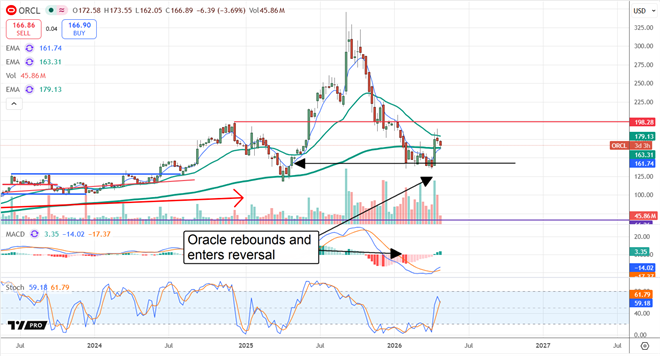
Insider and institutional selling align with Oracle’s 2025 price peak and subsequent pullback. The data shows both groups selling into the rally, unsurprising, given the massive run-up ORCL had seen. However, the data also aligns with the market bottom, with insider selling tapering off early in 2026 and institutions reverting to accumulation. The likely outcome is that institutions continue to accumulate, underpinning the stock price floor and the reversal indicated by the charts.
Oracle hit bottom in early 2026 and established its support base soon after. It was among the first, if not the first, to rebound after the AI-disruption-induced selloff, and it shows increasingly strong potential to continue to rebound. While subsequent price action created small red candles, they are at the top end of a larger green candle and above critical moving averages. The critical moving averages include the 30-day exponential moving average (EMA) and the longer-term 150-week EMA, which represent short-term traders and ultra-long-term buy-and-hold investors. With the two coming into alignment, a move above the 150-day EMA is likely, and would be a tipping point for reversal.

Analyst trends suggest the tipping point can be easily crossed. While a price-target reset played into ORCL’s price decline, the market overreacted. Takeaways in early Q2 include increased coverage, a firming Moderate Buy rating, a 75% Buy-side bias, and a steadying consensus target, forecasting 55% upside from the moving average cluster. A solid catalyst can easily send analysts back to price target increases and bring the high-end $400 target back into play. As it stands, a move to the consensus aligns with the middle of Oracle’s long-term range, while the high-end suggests more than 100% upside is possible.
Oracle Has Catalysts Ahead
The next visible catalyst is the company’s fiscal Q4 earnings release scheduled for early June. Oracle is expected to accelerate earnings growth and drive solid profits, but margins may contract. The rising debt load increases debt servicing costs, which will be reflected in the results. However, the guidance and backlog are the triggers, as the market needs to see a clear path to acceleration and better-than-anticipated long-term revenue and earnings. Non-visible catalysts include new deals, along with surprises in and surprise reactions to other AI leaders’ results.
And there is more than just a hyperscale story in play. Oracle’s core database business is also booming, and will continue to grow long after the datacenter frenzy subsides. Recent updates include a host of new agentic tools targeting enterprises across verticals, helping cement Oracle as a go-to source for AI infrastructure and services.
5 Stocks Our Experts Predict Could Double In the Next Year
By submitting your email, you'll also get a free pivot & flow membership. A free daily market overview. You can unsubscribe at any time.