
Executive summary:
- Large caps make new highs
- Major digital asset legislation signed during “Crypto Week”
- Earnings season kicks off with a strong start
- U.S. Dollar rallies on increasing trade deals
- FOMC holds rates steady
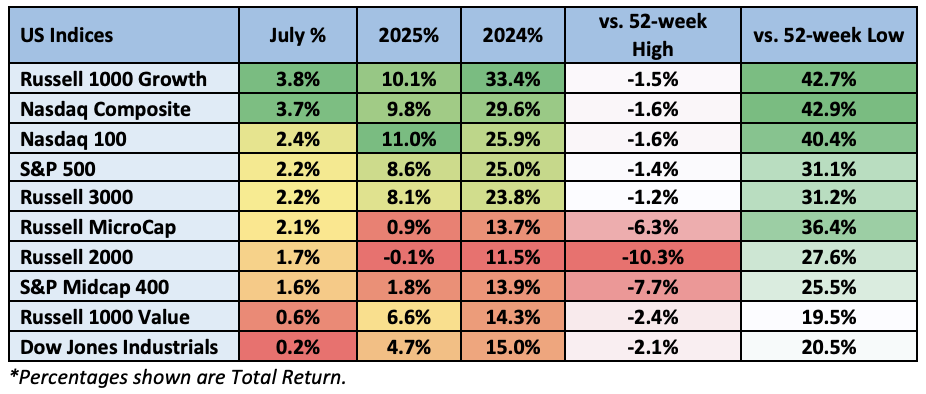
July continued the strong run for stocks seeing the S&P 500 up for the third month in a row, and the Nasdaq for the fourth. Interestingly, the S&P 500 didn’t have any significant moves of 1% in either direction, which hasn’t happened since July 2023. The VIX, a measure of market volatility, stayed relatively calm, ending the month around 17. Big tech stocks were the stars of the show, but other sectors like homebuilders, banks, auto suppliers, and oil majors also did well. On the flip side, sectors like logistics, entertainment, and media didn’t perform as strongly.
This month’s market rally pushed the S&P 500 and Nasdaq to new record highs, bouncing back from the post-Liberation Day selloff. The rally was fueled by easing tariffs and trade tensions, a strong start to the earnings season, and a resilient macroeconomic backdrop. Positive developments in the AI sector, increased deal activity, and the passage of the Big Beautiful Bill also helped boost market sentiment. Despite some concerns about rising interest rates, the market remained optimistic, supported by resilient economic data.
Trade agreements played a significant role in the market’s performance. The U.S. reached several trade deals before the August 1 deadline, including agreements with the EU and Japan. Talks with China showed signs of progress, with Treasury Secretary Bessent expressing optimism about the negotiations. However, trade tensions with Canada remained elevated, and a Federal appeals court heard arguments regarding the legality of tariffs. Investors focused more on the reduced uncertainty around trade policy rather than specific tariff levels, with AI momentum offsetting the tariff impact in certain sectors.
Economic data for the month was mixed. June payrolls exceeded expectations, and the unemployment rate ticked down to 4.1%. However, job growth is expected to slow in July. Initial jobless claims fell for six consecutive weeks before a slight uptick, while continuing claims remained high. CPI and PPI data came in cooler than expected, but housing data was generally weak. The Fed’s July meeting featured hawkish takeaways, with no hints of a rate cut in September. Tensions between President Trump and Fed Chair Powell continued, adding to market uncertainty.
Index performance for July:

Sector performance total return for July:

Digital Assets:
July kicked off with heightened anticipation ahead of “Crypto Week” which took place between July 14-18th aiming to address critical crypto legislation. The highlight was the passage of the Guiding and Establishing National Innovation for U.S. Stablecoins Act (GENIUS Act), which received a decisive 308-122 vote in the House on July 17 and was signed into law by President Trump on July 18. This landmark legislation establishes the first federal regulatory framework for payment stablecoins, introducing a two-tier licensing system. Stablecoin issuers with a market capitalization under $10 billion can obtain state-level licenses, while larger entities require federal licenses overseen by the Office of the Comptroller of the Currency (OCC). The law mandates that stablecoins be backed 100% by high-quality liquid assets like U.S. dollars or Treasuries, with monthly reserve disclosures, alongside strict anti-money laundering (AML), know-your-customer (KYC), and sanctions compliance requirements. This move aims to bolster consumer protection and integrate stablecoins into the regulated financial system, a significant step forward for digital payments.
Alongside the GENIUS Act, the Digital Asset Market Clarity (CLARITY Act) advanced, passing the House with a 294-134 vote on July 18. This bill seeks to resolve jurisdictional disputes between the Securities and Exchange Commission (SEC) and the Commodity Futures Trading Commission (CFTC), proposing a functional regulatory framework for digital assets. It aims to clarify oversight responsibilities and set clearer rules for market participants, though it still awaits Senate consideration. Additionally, the Anti-CBDC Surveillance State Act, passed narrowly by a 219-210 vote, prohibits the Federal Reserve from issuing a central bank digital currency (CBDC), reflecting concerns over privacy and government overreach. These bills collectively signal a shift toward regulatory clarity and innovation, though their Senate journey remains uncertain.
On the state level, Texas made history by establishing the first U.S. state-managed Bitcoin reserve, signed into law this month. The reserve, managed by the Texas Comptroller of Public Accounts with guidance from a crypto investment advisory committee, restricts eligible assets to those with a market cap exceeding $500 billion—currently only Bitcoin—and allows growth through purchases, forks, airdrops, gains, and donations. This move positions Texas as a leader in state-level crypto adoption, though Arizona’s Governor vetoed a similar Bitcoin reserve bill on July 1, highlighting divergent state approaches.
Looking forward, the Senate will play a critical role in shaping these initiatives. The GENIUS Act, already Senate-approved, could reach the president’s desk before the August recess if it passes without major revisions. The CLARITY Act and Anti-CBDC Act face more scrutiny, with potential debates extending into September, especially given partisan divides on CBDC issues. The Working Group’s July 22 report may influence these discussions, potentially proposing a “national digital asset stockpile” or additional legislative measures. Internationally, the EU’s Markets in Crypto-Assets (MiCA) regulation continues its phased implementation, with ongoing Level 2 and 3 text development, while the UK advances its cryptoasset regime, with final rules expected in 2026.
Earnings commentary:
With ~60% of S&P 500 companies reporting earnings for Q2’25, the results have been solid, but the outlook remains uncertain. So far this reporting cycle, just under 83% of companies are reporting EPS above estimates, which is above both the 5 and 10-year averages of 78% and 75% respectively. The aggregate earnings surprise is +7.3% currently, which is below the 5-year average of 9.1%, but above the 10-year average of 6.9%. Positive EPS surprises are being led by the Energy sector which has printed +12.7% above estimates, followed by Financials (10.8%) and Communications (9.0%). Only Industrials has had a negative EPS surprise which came in 2.4% below estimates.
On growth front, more sectors are in the red, but the overall earnings growth is well above recent trends. Currently the average earnings growth rate stands at 9.5%. There are currently six sectors reporting EPS growth, led by Technology (21.6%), Financials (20.3%), and Communications (18.8%), while Consumer Discretionary (-19.5%), and Health Care (-8.1%) are the clear laggards.
Sales surprises and growth are also trending well, with nine sectors reporting positive sales growth, with only Energy (-5.8%) and Consumer Discretionary (-0.3%) reporting contractions. The average sales growth figure for the quarter currently sits at 6.6%. Sales surprises for the first quarter are led by Energy companies with an average beat of 6.9%, with Materials lagging with a 0.9% average surprise. The overall upside sales surprise being reported to date is 2.6%.
Sales and earnings results by S&P sector:

2-day price reaction following earnings releases:

Earning Call Mentions:
Tariffs

Generative AI

Fed rate cut odds:

Bitcoin:

DXY:

GDP rose in Q2 led by net exports:

Trade Deals:

Looking ahead:
August will bring the conclusion of Q2’25 earnings season, as well as further economic data including jobs, inflation and GDP. While the Federal Reserve will not meet again until mid September, the August data will be key drivers of their potential policy changes. Over the last 15 years, the month of August has seen an average return of -0.45%, with 8 years in the red and 7 in the green. Only September saw worse returns during that time frame with an average return of -0.94%.
Economic Calendar:

The information contained herein is provided for informational and educational purposes only, and nothing contained herein should be construed as investment advice, either on behalf of a particular security or an overall investment strategy. All information contained herein is obtained by Nasdaq from sources believed by Nasdaq to be accurate and reliable. However, all information is provided “as is” without warranty of any kind. ADVICE FROM A SECURITIES PROFESSIONAL IS STRONGLY ADVISED.
5 Stocks Our Experts Predict Could Double In the Next Year
By submitting your email, you'll also get a free pivot & flow membership. A free daily market overview. You can unsubscribe at any time.