
announced plans to discontinue its physical gaming discs starting in 2028. According to the company, the move is being made to coincide with consumer preferences. That sentiment is backed up by Take-Two Interactive, which announced that its latest version of Grand Theft Auto will be available exclusively in a digital format.
SONY hasn’t moved much since the announcement, and for good reason. The issue of physical discs doesn’t address the larger threat that’s facing the gaming industry as a whole.
For updates on that front, investors will have to wait for the company’s earnings report, which is due in early August.
Memory Costs Remain Sony’s Biggest Gaming Headwind
The short-term reaction to the phase-out news was predictable. The decision will lead to cost savings, which investors love. It also has the potential to improve margins.
But it does nothing to address the memory issue, which will still be front and center for Sony and other gaming companies, such as Microsoft. Microsoft has recently announced company-wide layoffs of up to 4,800 workers. However, most of those displaced will come from its gaming division, which is struggling with higher memory costs for its Xbox.
Sony faces those issues with its PlayStation console, but on a much greater scale. Sony’s PlayStation 5 currently dominates in market share with an estimated 75 million active units globally. That’s a stark contrast to the 30 million units sold across the Xbox Series ecosystem.
That means the company faces a memory issue that’s literally twice as large as that of Microsoft and even more so than that of Take-Two.
Sony’s Move Away From Discs Raises Ownership Concerns
Sony’s decision, on top of Take-Two’s move, is a shot across the bow at a company like GameStop, which still generates a significant share of its revenue from physical gaming hardware, including discs. But that’s been a known issue for years. GameStop has closed over 1,300 stores in the last two fiscal years due to dwindling demand for physical games.
The real backlash is coming from collectors and physical media loyalists who have now lost the ability to resell, lend, or buy used games. Eliminating discs ties ownership more tightly to platform accounts/servers. The argument is that the absence of physical discs eliminates the second-hand market and gives consumers no alternative to the PlayStation Store. That means after 2028, Sony will be the only arbiter over what a game costs and how long users can use it.
On one level, the concerns hold some merit. If Sony decides to delist a title, gamers who don’t own the physical disc could lose access entirely. Even if they have a physical disc, the functionality will be limited to that version.
Those concerns are coming to a head in a lawsuit by a Dutch law firm, which is seeking $457 billion dollars in damages. The “Fair PlayStation” campaign addresses the “Sony tax,” which refers to the 30% commission that Sony levies on all products sold through its stores.
Plus, the announcement comes shortly after Sony raised the price of its disc-edition PlayStation to $649.99 from $549.99—a not-so-subtle way to nudge consumers to higher-margin digital sales. It may be a coincidence, but the optics give the critics some validity.
However, the real erosion of consumer ownership rights is mostly an argument dressed in nostalgia’s clothing. No privacy rights are being lost, and Sony’s larger point is correct. More gamers are simply choosing to download the updated version of a game.
SONY Stock Analysis: Technical Signals Point to Limited Upside
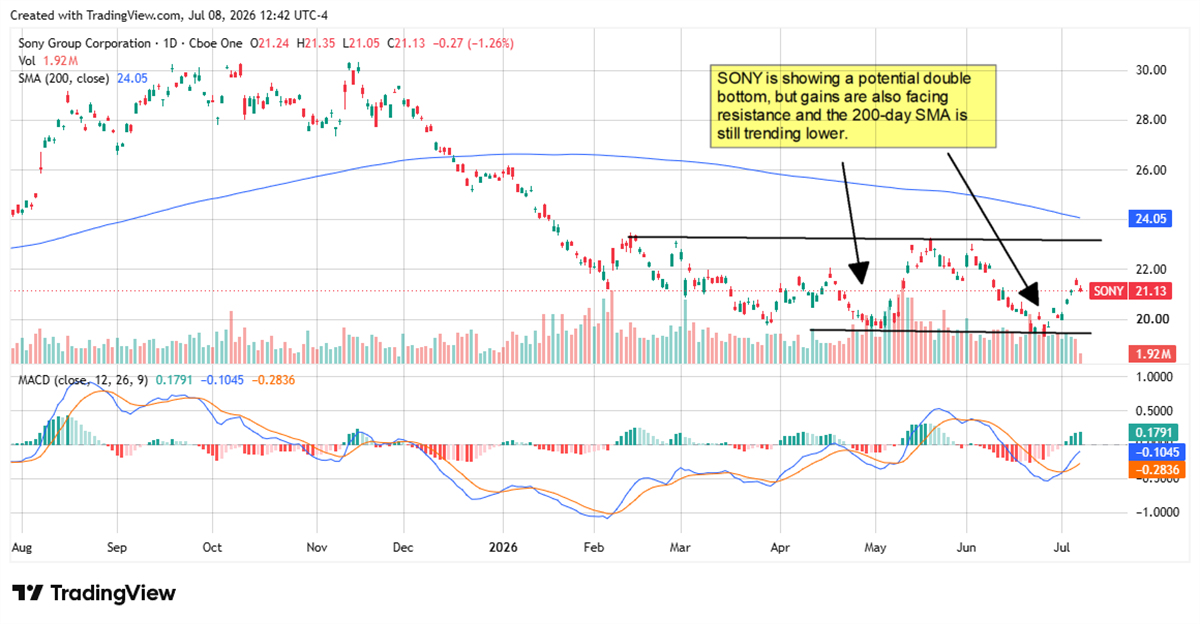
SONY is down about 17% in 2026. The good news is that it looks like it’s formed a bottom at just under $20 per share. The concern is that the upside may be limited without better momentum.
The Sony analyst forecasts on MarketBeat show a consensus price target of $22, which leaves less than 4% by way of upside. Assuming earnings growth of around 10% in the next 12 months, the company’s annual dividend looks safe and may increase. But the yield of 0.5% may not be enough to keep investors interested.
The daily chart supports a case for cautious optimism, but with a big asterisk. Shares have climbed off their recent low to about $21, and the MACD line has crossed above its signal line, a bullish signal that often precedes further near-term gains. That said, the stock remains well below its 200-day simple moving average of $24.05, a level SONY hasn’t reclaimed since December 2025.
 That gap between improving short-term momentum and a still-declining long-term trend line is exactly why the upside looks capped. A bounce off support isn’t the same as a confirmed reversal, and bulls likely need a close above the 200-day average before the broader downtrend is truly broken.
5 Stocks Our Experts Predict Could Double In the Next Year
By submitting your email, you'll also get a free pivot & flow membership. A free daily market overview. You can unsubscribe at any time.