
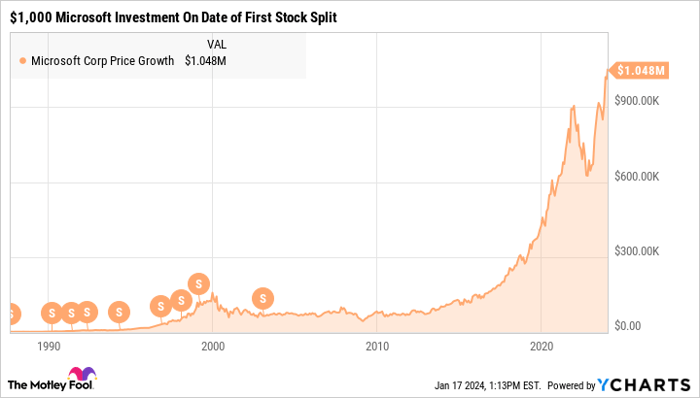
Tech-giant Microsoft (NASDAQ: MSFT) has a storied history of executing nine stock splits since its initial public offering (IPO) in 1986. If an investor had purchased a single share on the day of Microsoft’s IPO and held it through the subsequent splits, that lone share would have grown to a substantial 288 shares today. A $1,000 investment in Microsoft at the time of the first stock split in 1987 would be valued at $1.05 million today.
It’s been nearly two decades since Microsoft last executed a stock split in February 2003, causing many to wonder if the tech titan is due for another split in the near future.
While there are no guarantees, a stock split often signifies the board of directors and management’s confidence in the company’s continued growth. This confidence is generally seen as a positive sign by investors, albeit a split doesn’t inherently create additional value or new investment opportunities.
Trading at $389 per share with a market capitalization of $2.9 trillion, Microsoft’s stock price remains at a lofty height, prompting speculation about the company’s future potential moves.

It’s the same delicious pizza pie whether you slice it in eight pieces or 16. Image source: Getty Images.
Microsoft’s AI Dominance
Microsoft’s stock performance has been exceptional in the wake of OpenAI’s introduction of the ChatGPT system. The company’s significant $13 billion investment in OpenAI, coupled with the integration of AI capabilities into its Azure platform and enterprise software, has positioned Microsoft at the forefront of the AI revolution.
This aggressive AI strategy has yielded tangible results, with Azure AI services experiencing rapid growth and the potential for revenue upticks from AI-enhanced products such as Microsoft 365. Bill Gates once remarked that the development of AI is as pivotal as the advent of the microprocessor, the personal computer, the internet, and the mobile phone, suggesting that Microsoft’s leading role in the AI revolution could propel its long-term growth to unprecedented heights.
See also <!DOCTYPE html><html lang="en"><head> <meta charset="UTF-8"> <meta http-equiv="X-UA-Compatible" content="IE=edge"> <meta name="viewport" content="width=device-width, initial-scale=1.0"> <title>The Nasdaq's Record-Breaking Surge: Unveiling the Key Stocks Behind the Milestone</title></head><body> <article> <h2>The Nasdaq Composite Ascends to Unprecedented Heights</h2> <p>After years of dormancy, the <strong>Nasdaq Composite</strong> <span class="ticker" data-id="220473">(NASDAQINDEX: ^IXIC)</span> triumphantly shattered its 2021 record on the final day of February. While the future trajectory of the Nasdaq remains obscured, astute investors can examine the pivotal stocks that likely propelled the index to this remarkable zenith.</p> <h2>The Power of Nvidia</h2> <p>Envision no astonishment when recognizing the integral role played by artificial intelligence chip purveyor <strong>Nvidia</strong> <span class="ticker" data-id="204770">(NASDAQ: NVDA)</span> in the Nasdaq's meteoric ascent. Nvidia's substantial 240% surge over the past year, dwarfing the Nasdaq's 40% climb, coupled with its weighty 5.03% index representation, elucidates its proclivity as a major driving force behind the index's recent success.</p> <h2>The Amazon Phenomenon</h2> <p>Fronted by e-commerce and cloud behemoth <strong>Amazon</strong> <span class="ticker" data-id="202816">(NASDAQ: AMZN)</span>, another stalwart that has outpaced the index with an 87% upsurge in the last year, doubling the Nasdaq's performance. With a weight of approximately 6.45% - ranking as the third-largest in the index - Amazon's triumph significantly influences the broader index's trajectory.</p> <h2>The Dominance of Alphabet</h2> <p>Underestimated as a colossal contributor to the Nasdaq Composite, internet titan <strong>Alphabet</strong> <span class="ticker" data-id="288965">(NASDAQ GOOG)</span> <span class="ticker" data-id="203768">(NASDAQ: GOOGL)</span> stealthily ranks as a substantial segment due to its dual-share structure. Notably, with the amalgamation of Class A and C shares, Alphabet surpasses Amazon as the Nasdaq's third-highest weighting at 6.72%. The stock's impressive 50% surge over the past year fortifies the Nasdaq's soaring trajectory.</p> <h2>Impending Storms: Apple and Microsoft's Looming Influence</h2> <p>However, looming on the horizon are the ramifications of Nasdaq's heaviest hitters, <strong>Apple</strong> <span class="ticker" data-id="202686">(NASDAQ: AAPL)</span> and <strong>Microsoft</strong> <span class="ticker" data-id="204577">(NASDAQ: MSFT)</span>, collectively constituting a colossal 23.8% of the entire index. Apple, trailing the index by nearly half in the past year, and Microsoft, exhibiting a robust 65% price appreciation, face elevated valuations that could potentially impede their future growth. The divergent paths of these tech titans may wield a profound impact on the Nasdaq's trajectory.</p> <p>The potential acme of these stocks to languish or falter owing to their lofty valuations poses a looming threat to the Nasdaq's exuberance. The tug-of-war between ascending and descending stocks will likely be pivotal in shaping the index's course ahead.</p> <p>For investors navigating these turbulent waters, deploying a diversified investment approach, adhering to long-term investment perspectives, and gradually acquiring positions can safeguard against unwelcome market volatilities.</p> <footer> <p>Should you invest $1,000 in NASDAQ Composite Index right now?</p> </footer> </article></body></html><!DOCTYPE html><html><head> <title>Investor Insights: NASDAQ Composite Index</title></head><body> The Unvarnished Truth About Investing in NASDAQ Composite Index
Furthermore, Microsoft’s recent acquisition of video game giant Activision Blizzard is expected to drive substantial changes throughout the company’s entire business.
With these developments in mind, a stock split in 2024 seems plausible as Microsoft stands at the cusp of a new business era.
Impact of a Stock Split on Shareholder Value
In the modern era, where most brokerages support fractional share trading and transactions are typically fee-free, the impact of a stock split on shareholder value may be less significant than in the past. Whether or not Microsoft opts to initiate a stock split, investors have easy access to fractional share trading, allowing for comparable investment opportunities.
While Microsoft’s future actions remain uncertain, potential investors are advised to conduct due diligence and rely on their own analyses when making investment decisions, and not rely solely on the possibility of a stock split.
5 Stocks Our Experts Predict Could Double In the Next Year
By submitting your email, you'll also get a free pivot & flow membership. A free daily market overview. You can unsubscribe at any time.