
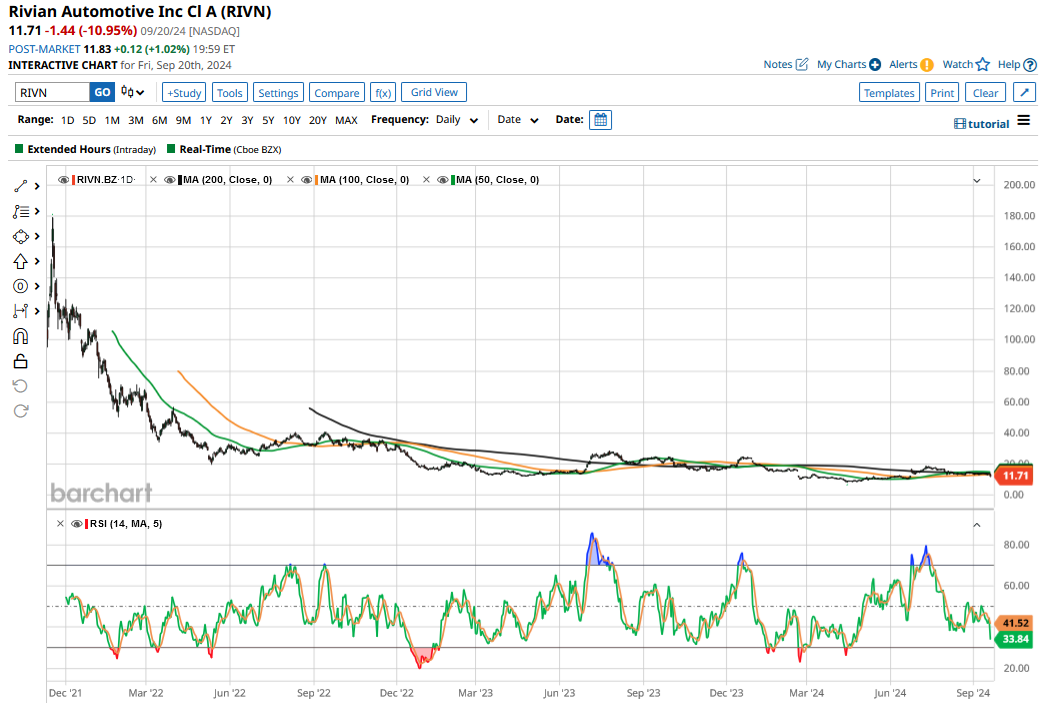
Although Rivian (RIVN) stock has slightly rebounded from its historic lows, it remains entrenched in a slump, staggering around 50% lower for the year, and languishing below $12 per share, boasting a diminutive market cap less than $12 billion. The electric vehicle (EV) novice soared onto the public trading arena in late 2021, orchestrating shares starting at $78. Within an ephemeral span, RIVN shares catapulted to an intraday zenith of $179.47, propelling the company’s market cap to a lofty pinnacle above $150 billion.
Rivian amassed a staggering $12 billion during its colossal IPO, which effectively stood as the most considerable offering on Wall Street since the dawn of Facebook, now rebranded as Meta Platforms (META). Fast forward to 2024, and RIVN now lingers at a fraction of its peak valuations. What lies beneath the disheartening plunge of Rivian stock, and could the Federal Reserve’s rate adjustments pave the path for RIVN to regain its lost ground – especially given that surging interest rates precipitated part of RIVN’s downfall? This narrative will unfurl within the confines of this analysis.

The Electric Vehicle Bubble: A Historical Snapshot
The electric vehicle bubble saw its apogee in late 2021, coinciding with Rivian’s initial public offering. In hindsight, the notion of a fledgling EV entity commanding a market capitalization exceeding $150 billion signified a looming bubble within the industry. Tesla’s (TSLA) market valuation also peaked in Q4 2021, cresting over $1.2 trillion.
An inundation of EV startups inundated the public markets between 2020 and 2021, leveraging the burgeoning enthusiasm for sustainable energy enterprises. A multitude of companies with unproven merchandise and technologies pioneered their initial public offerings during that epoch, commanding exorbitant valuations. Concurrently, the pervasive optimism towards EV equities, coupled with the generous availability of cheap capital, propelled practically every green energy enterprise’s stock price to stratospheric altitudes.
The Deceleration of EV Equities Amid Maturing Markets and Climbing Interest Rates
The crumbling of the EV bubble commenced in 2022 as it became apparent that the transition to green energy might not unfold as briskly as the market had foreseen. Even Tesla grappled with dwindling sales figures and relinquished its objective of expanding deliveries at the previously aspired 50% CAGR. The ebbing demand and burgeoning production capacities birthed the EV pricing warfare, exacerbating the losses of EV enterprises – or more aptly, accentuating their financial hemorrhage.
The Federal Reserve’s ratcheting up of interest rates, instigated in March 2022, effectively dealt a death knell to the loss-making growth equities – a category encompassing nearly all startup EV firms. As central bankers worldwide moderated the flow of easy money and U.S. interest rates scaled to multi-year peaks, investors steered clear of unprofitable stocks, including those within the EV ambit.
The Tale of Rivian’s Dismal Stock Performance
Rivian’s travails mirror those of its fellow startup EV counterparts, with the stock plummeting amidst the pervasive pessimism surrounding the industry. Nevertheless, distinct from myriad other fledging EV entities that are dubiously poised to endure beyond a couple of years, Rivian garners a position among the premium brands within the cohort.
The company boasts an enticing product portfolio, an esteemed managerial cadre, a relatively robust balance sheet, and endorsement from prestigious entities such as Amazon (AMZN) and Volkswagen (VWAGY). Earlier this year, the German auto behemoth pledged a $5 billion investment in Rivian, underscoring the company’s reservoir of exceptional intellectual property. Significantly, this move infused the critical liquidity essential for Rivian to actualize its R2 and R3 vehicle production plans.
The Impact of the Fed’s Rate Cuts on Rivian
Although the Fed’s interest rate hikes posed hurdles for growth stocks like Rivian, the prospect of RIVN revisiting its zeniths seems distant, even with the Fed’s current shift towards rate reductions. Federal Reserve Chair Jerome Powell unequivocally affirmed that the notably amplified 50-basis point cut doled out recently will not mark a permanent paradigm shift and nixed the notion of a prolonged era of ultra-cheap capital that the markets grew accustomed to between 2020 and 2021.
While the Fed’s rate trimming should bolster vehicle sales, one should not await miracles, as the EV sector grapples with substantial overcapacity.

That being said, the Federal Reserve’s rate cuts harbor incremental benefits for Rivian on various fronts. Firstly, a normalized rate environment augurs well for growth entities like Rivian. Subsequently, reduced rates are poised to induce a modicum of enhancement in EV sales, unless a recession ensues. Finally, diminished rates will alleviate capital market constraints, potentially enabling Rivian to secure capital under more favorable conditions.
Is Investing in RIVN at Its Current Low Worthwhile?
I perceive Rivian stock to present a compelling investment opportunity at its present valuation, courtesy of the enticing risk-reward equilibrium it offers, with the stock’s upcoming 12-month price-to-sales multiple of 2.25x appearing reasonably appealing. Rivian’s delivery trajectory is poised for improvement over the forthcoming years, a development that will ameliorate fixed cost absorption.
Incidentally, RIVN aims to achieve a “modest” gross profit in Q4 – an attainment that would constitute a pivotal milestone. Despite the company’s anticipated continuance of cash burn and net losses in the forthcoming quarters, a positive gross margin marks the foundation for constructing a sustainable enterprise. On the whole, while the EV sector grapples with challenges and the Federal Reserve’s rate adjustments do not unequivocally warrant investment in all entities, my bet stays on RIVN, with a resolve to retain my shares.
For further Stock Market News from Barchart
5 Stocks Our Experts Predict Could Double In the Next Year
By submitting your email, you'll also get a free pivot & flow membership. A free daily market overview. You can unsubscribe at any time.