
Zuckerberg Seeks 'Active Role' In Trump's Tech Policies, Says Top Executive — Admits Meta 'Overdid It' During Pandemic Content Crackdown

Written By Michael Gary Scott

Meta Platforms, Inc. META CEO Mark Zuckerberg is seeking to play an “active role” in shaping technology policies under the administration of President-elect Donald Trump.

What Happened: On Tuesday in a briefing with journalists, Nick Clegg, Meta’s president of global affairs, said that Zuckerberg intends to play “an active role” in discussions about preserving U.S. leadership in technology, reported the Financial Times.

Last week, it was reported that Zuckerberg met with Trump at Mar-a-Lago, expressing gratitude for the invitation.

Clegg also admitted that the company “overdid it a bit” with content moderation during the pandemic, which seems to be an effort to appease Trump, who has accused Meta of censorship.

See Also: BYD Surpassed Tesla In Quarterly Revenue For The First Time In Q3. It Assembles Over 30% Of iPads For Apple, And Is Now Planning To Build AI Robots For Nvidia

The Meta executive said that the company is committed to refining its content moderation practices to ensure “precision and accuracy,” admitting the company has faced user backlash over removing non-harmful content.

Why It Matters: Earlier this year, Trump had threatened legal action against Zuckerberg, accusing him of plotting against him while appearing friendly during visits to the Oval Office.

In July this year, Meta lifted additional restrictions on Trump’s accounts, after he threatened to take legal action against Zuckerberg.

Meanwhile, Meta reported third-quarter revenue of $40.59 billion, surpassing analyst expectations of $40.29 billion. The company also reported adjusted earnings of $6.03 per share for the quarter, exceeding the projected $5.25 per share.

See also  The Role of Emerging Managers in Venture Capital Delving into the World of Emerging Venture Capital Managers

Embarking on a journey through the intricate landscape of venture capital, we encounter a dichotomy that pits the seasoned veterans against the up-and-coming newcomers. A recent analysis by Pitchbook delves into the realm of Emerging Managers and their impact on the world of investments. Established managers, with their wealth of experience and proven track records, often bask in the trust of Limited Partners. In contrast, emerging managers, without such historical accolades, rely heavily on forward-thinking narratives and innovative approaches.

Like a gust of fresh air in a room long occupied, emerging managers in sectors such as venture capital have displayed a consistent outperformance trend since the late 1990s. However, this path to success is not without its bumps and hurdles, as volatility in returns tends to be higher for emerging managers compared to their established counterparts.

The Trends and Insights Unveiled

Within the realm of venture capital, the period between 2010 and 2019 saw simulations indicating that portfolios managed exclusively by emerging talents yielded a median return higher than those helmed by established figures. The shining stars among the emerging managers stood out boldly, showcasing superior performance compared to their seasoned peers, albeit with a wider spectrum of returns and a touch of unpredictability.

Specialization emerges as a critical key to success in the venture capital arena, with specialists consistently outshining generalists across both established and emerging manager categories. The ability to hone in on a specific sector provides an undeniable edge, as founders often gravitate towards sector-focused funds. Such advantages become even more apparent with higher Internal Rates of Return (IRRs) observed among specialist funds in both the top and bottom quartiles.

The Dance of Size and Strategy

For the established guard to maintain their leading positions, periodic evaluations of size and strategy become imperative. Sticking to a familiar market segment and a particular fund size bracket - with funds exceeding $250 million found to offer the most stable returns - holds the key. On the flip side, intentional size restraint among smaller established funds (under $250 million) can lead to significant returns, albeit with a wider performance dispersion.

Even giants like Andreessen Horowitz have ventured into new realms, expanding their horizons and fund sizes while exploring different venture stages. While emerging managers have been hailed for their high returns laced with greater volatility, the safety net of established funds remains a comforting thought for Limited Partners, especially when aiming to minimize downside risks.

Monday Market Highlights

General News:

Despite a pullback in LP investments in venture capital, a select cohort of VC firms continues to raise substantial sums. From General Catalyst's $6 billion VC fund to Andreessen Horowitz's $7.2 billion across various strategies, the VC world remains rife with activity. Rappi introduces its new global CFO, Tiago Azevedo, as part of their expansion strategy in LatAm. Brazilian fintech Urbano Bank shines with impressive Q1 results, showcasing robust growth in net revenue, accounts, and TPV. Google for Startups launches an AI acceleration program, nurturing AI startups like Advolve, Beep Saúde, and Merama in Brazil.

Deals:

Brazilian startup Yuna secures R$ 8 million in a pre-seed round, fueling its AI-driven children's content creation platform with backing from notable investors. Financial News Round-Up Insights into the Financial Landscape

Subscribe to the Benzinga Tech Trends newsletter to get all the latest tech developments delivered to your inbox.

This marks the seventh straight quarter in which Meta has outperformed analyst estimates for both revenue and earnings, according to Benzinga Pro.

Price Action: Meta’s stock rose 3.51% on Tuesday, finishing the day at $613.65. During after-hours trading, it saw a slight uptick of 0.059%, reaching $614.01. Year-to-date, Meta’s shares have surged by 77.21%, significantly outperforming the Nasdaq 100 index, which has gained 28.32% in the same period.

Based on evaluations from 41 analysts, Meta’s consensus price target stands at $639.05, with the highest projection of $811 issued by Rosenblatt on Oct. 31, 2024. Recent ratings from Raymond James, Wells Fargo, and Citigroup average at $673.67, implying a potential 9.72% upside.
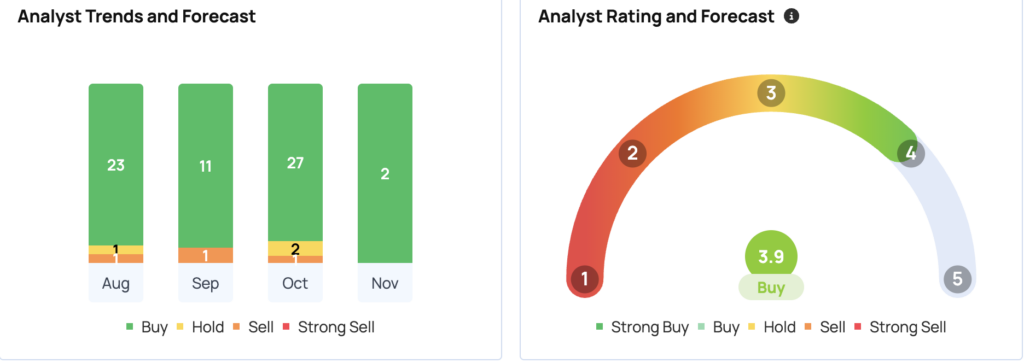
Image via Shutterstock

Check out more of Benzinga’s Consumer Tech coverage by following this link.

Read Next:

Disclaimer: This content was partially produced with the help of Benzinga Neuro and was reviewed and published by Benzinga editors.

Market News and Data brought to you by Benzinga APIs